
Australia’s rarest
— Rainforest ACCUs
— Nature Repair Market Certificates
— Rainforest climate cooling offsets
What we do
24 Degree Forest develops premium biodiversity and rainforest restoration projects on steep slopes, and riparian zones.
Our projects restore climate function, reconnect fragmented habitat and create long-term ecological resilience across Australian landscapes.
ACCUs are not our end product, but at the right price, they have the potential as a financial mechanism to enable large scale long-term rainforest restoration.
24 Degree Forest’s high density planting ACCUs are strongly differentiated when compared with typical low density environmental planting ACCUs.
Our high density projects are optimised for:
active climate cooling
fire resilient landscapes
a legacy where rainforest and agriculture co-exist
cleaner air and water
threatened species recovery
World Heritage ecosystems expansion
more beautiful places, where people and animals can thrive
If it is too steep to cultivate, it never should have been cleared.
At 24 Degree Forest, we are putting rainforest, with all its benefits, back where it belongs.
Australia has a climate and ecosystem problem that conventional carbon markets are not designed to solve
Australia is becoming hotter, drier and more fire-prone.
Yet much of the ACCU market has optimised itself around low-cost carbon sequestration rather than long-term ecosystem function.
A market where ‘an ACCU is an ACCU is an ACCU’ may standardise the ACCU as a commodity but it also risks undervaluing biodiversity, ecological complexity and other co-benefits. This is especially true for rainforest projects.
The Nature Repair Market has the potential to help fill this gap by creating the differentiation required to better align financial incentives with ecological outcomes across the full spectrum of Australian ecosystems. This creates a pathway for both lower-cost restoration projects and high-complexity ecosystem restoration projects to become economically viable over the long term.
Environmental planting projects are typically optimised around FullCAM, methods and mapping guidelines to maximise financial efficiency. Because planting density is one of the largest variable cost drivers, many projects minimise stem densities while still achieving similar carbon yields under FullCAM. Current premiums on ACCU prices appear to compensate only for moderate increases in density.
Current ACCU pricing structures provide insufficient financial incentive for the restoration of dense, structurally complex ecosystems. In practice, projects lose economic viability for every additional tree planted beyond typical densities because carbon yields under FullCAM do not increase sequestration yield as density increases.
The result is a carbon market dominated by relatively low-density planting designs.
But some of Australia’s most ecologically valuable ecosystems—including rainforest—do not function this way.
Rainforest ecosystems require exceptionally high planting densities and structural complexity to restore its critical ecological function, often requiring 2,500 to 3,500 stems per hectare compared to more typical low-density plantings of approximately 400-600 stems per hectare.
Conventional carbon markets provide little financial incentive for this level of restoration complexity.
In addition, subtropical landscapes are fragmented into small, expensive landholdings.
As a result, many of Australia’s most climate-resilient ecosystems remain economically excluded from restoration at scale.
Australia’s 2nd
Nature Repair Market Project
1st to plant 2,500+ stems per hectare
1st to include restoration target level 3
Extension of World Heritage Gondwana Rainforest and Wet Sclerophyll on unproductive steep slopes - Doon Doon NSW
Active climate cooling benefits
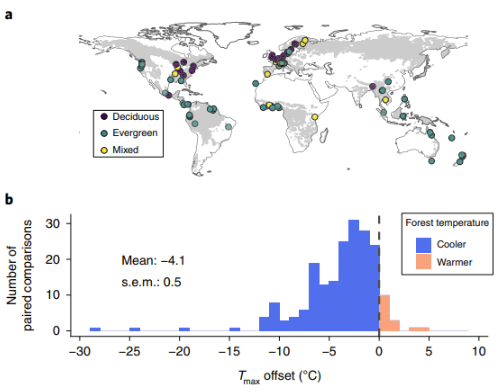
Dense closed-canopy rainforest systems can reduce peak temperatures by up to 4.1°C relative to open landscapes.
While most carbon offset projects focus primarily on sequestration outcomes, dense closed-canopy rainforest systems also provide substantial local temperature buffering, moisture retention and fire resilience functions that are largely absent from sparse woodland systems.
These ecological cooling effects are well established in scientific literature but remain largely unpriced within conventional carbon markets.
Global studies demonstrate that closed-canopy forests materially buffer maximum and mean temperatures relative to open woodland forest
(De Frenne et al., 2019).
Dense Canopy Cooling Capacity
Research demonstrates that dense forest canopies materially reduce local temperature extremes through canopy closure, evapotranspiration, shading and moisture retention.
Dense closed-canopy forests (>70% canopy cover) have been shown to reduce maximum temperatures by up to 4.1°C relative to open landscapes (De Frenne et al., 2019; Mwamulima et al., 2025).
Sparse open woodland systems (30–70% canopy cover) achieve substantially lower temperature buffering (~0.2°C to 0.4°C).
Increased canopy density and structural complexity also improve soil moisture retention and reduce drought stress during extreme heat events.
Fire Refugia
Dense rainforest systems maintain:
higher fuel moisture
lower ground temperatures
reduced grass fuel loads
more stable microclimatic conditions
Scientific literature demonstrates these characteristics can materially reduce wildfire susceptibility compared to open pasture and sparse woodland systems.